How to Get Your Church Found on Google: A Practical Guide for Pastors
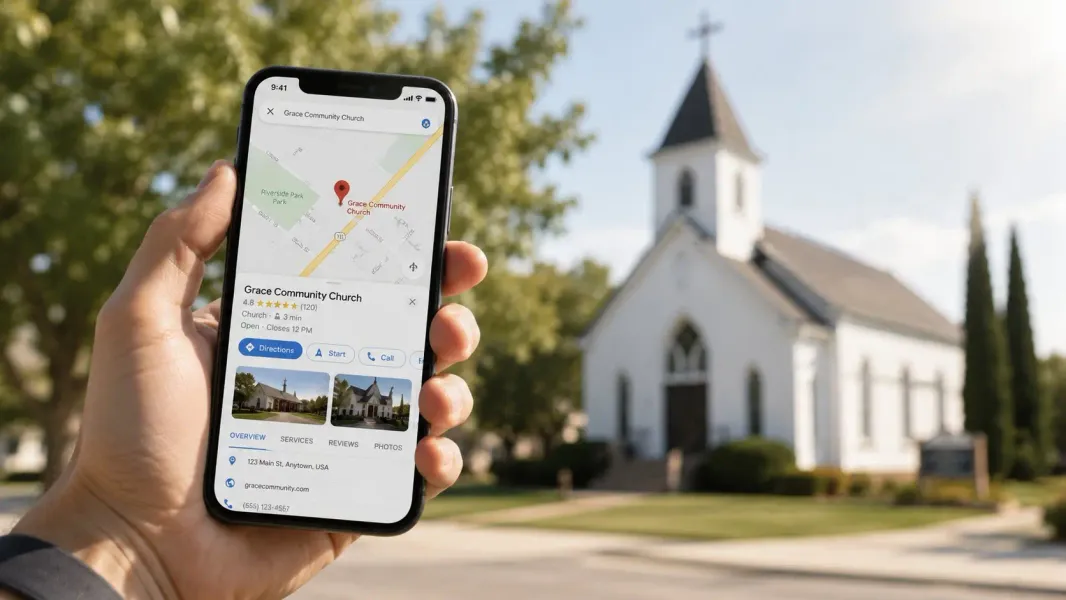
Every week, people in your city are typing things like “church near me,” “Baptist church [your city],” or “Sunday church services” into Google. If your church doesn’t show up in those results, those people will never find you — no matter how good your preaching is or how welcoming your congregation is.
Getting found on Google is not about gaming the system or learning complicated technical strategies. For a local church, it mostly comes down to a few fundamentals done consistently. This guide covers exactly what you need to know, without the jargon.
Why Most Churches Don’t Show Up on Google
Before we talk about solutions, it helps to understand why the problem exists.
Google’s job is to show people the most relevant, trustworthy result for whatever they’re searching for. When someone searches “church in [your city],” Google looks at several signals to decide which churches to show — and in what order.
If your church has no website, Google has almost nothing to work with. If you have a website but it’s outdated, poorly structured, or missing key information, that’s nearly as bad. And if you haven’t claimed your free Google Business Profile, you’re invisible to an entire category of local search results.
The good news is that fixing these things doesn’t require an advanced degree in marketing. It just requires doing a few specific things right.
Step 1: Claim and Optimize Your Google Business Profile
This is the single highest-impact thing you can do for local visibility, and it’s completely free.
Your Google Business Profile (formerly Google My Business) is what powers the map results and the information panel that appears when someone searches for your church by name or searches for churches near them. If you haven’t claimed yours yet, go to business.google.com and set it up.
Once your profile is claimed, make sure the following are accurate and complete:
- Church name — Use your actual church name, not a keyword-stuffed version
- Address — Make sure it’s correct and matches what’s on your website
- Phone number — Current and answered during office hours
- Website URL — Link to your church website
- Service hours — List your regular Sunday service times
- Description — A few sentences about who you are and who you serve
- Photos — Add real photos of your building exterior, interior, and congregation (with permission)
The description is worth writing carefully. Include your city and neighborhood naturally, mention your denomination or worship style if it helps people self-select, and write it for the person who’s never heard of you.
Step 2: Make Sure Your Website Has the Right Information
Your website and your Google Business Profile work together. Google looks for consistency between the two, and so do the people who find you.
At minimum, your website needs to clearly display:
- Your church’s full name
- Your physical address
- Your service times
- A phone number or contact form
These should be easy to find — not buried in a footer no one scrolls to, but visible and prominent. If someone lands on your homepage and can’t find your address within ten seconds, that’s a problem both for visitors and for how Google evaluates your site.
Beyond the basics, your website should include content that uses natural, location-specific language. Mentioning your city, neighborhood, and the areas you serve throughout your site helps Google understand where you’re located and who you’re relevant to.
Step 3: Get Listed in Local Directories
Beyond Google, there are other online directories that help establish your church’s presence and credibility online. The most important ones:
- Apple Maps — Significant if your congregation uses iPhones
- Bing Places — Microsoft’s equivalent of Google Business Profile
- Yelp — People actually search for churches here
- Facebook — Keep your address and hours current
- Church-specific directories like ChurchFinder or local denominational listings
The key is consistency. Your church name, address, and phone number should be identical across every listing. Even small differences — “St.” versus “Street,” a suite number listed differently — can confuse search engines and weaken your overall presence.
Step 4: Ask Members to Leave Google Reviews
Google reviews are one of the signals Google uses to rank local businesses and organizations. A church with 20 genuine reviews will generally rank better than a church with no reviews, all else being equal.
More importantly, reviews are one of the first things a searching family will look at when evaluating your church. A few genuine reviews from members describing what makes your church community special can be more persuasive than anything on your website.
Ask your engaged members to leave a Google review. Keep it simple — “Would you be willing to share a quick Google review about your experience at our church? It helps families in [city] find us.” Most people are happy to help when asked directly.
Don’t manufacture reviews, don’t offer incentives, and don’t ask people to post reviews from the same location at the same time. Keep it genuine and spread out naturally.
Step 5: Create Content That Answers Questions People Search For
This is where a church blog becomes a real strategic asset. People in your city are searching for answers to questions like:
- “Does my church need a website?”
- “What to expect at church for the first time”
- “Churches with kids programs in [city]”
- “Is [your denomination] right for me?”
If your website has content that answers these questions well, Google may surface your site to people searching for them. Over time, this kind of content builds what SEO professionals call “topical authority” — Google’s confidence that your site is a credible source on church-related topics in your area.
You don’t need to publish every week. Even one or two well-written posts per month, focused on questions your community actually asks, will build meaningful search visibility over time.
What “Near Me” Searches Mean for Your Church
When someone types “church near me” into Google, the results they see are determined by their location at the time of the search. This is entirely driven by your Google Business Profile and your website’s local signals — not by anything you can control in the moment.
This means the work you do upfront — claiming your profile, keeping it updated, building a credible website with location-specific content — pays dividends every single week as people search from their phones near your building.
Common Mistakes That Hurt Church Search Rankings
A few things worth avoiding:
Neglecting your website. An outdated site with wrong service times or broken links signals to Google — and to visitors — that your church may not be active. Search engines favor sites that are maintained and regularly updated.
Keyword stuffing. Don’t try to game the system by loading your pages with repetitive phrases like “best church in [city] church services [city] Sunday church.” It reads poorly to visitors and Google penalizes it.
Ignoring mobile users. More than half of local searches happen on phones. If your site doesn’t work well on mobile, you’re losing both visitors and search ranking.
Not responding to reviews. When someone leaves a Google review — positive or negative — responding shows that your church is engaged and cares about its community. It also signals to Google that your profile is actively managed.
Setting it and forgetting it. Local SEO is not a one-time task. Your Google Business Profile needs to stay current. Your website needs to stay maintained. Reviews need to accumulate over time. It’s a long game, but a manageable one.
You Don’t Need to Be an SEO Expert
None of this requires deep technical knowledge. The fundamentals of local church SEO come down to: claim your Google presence, build a good website with clear information, get listed in the right directories, collect genuine reviews, and create occasional content that answers real questions.
That’s it. If you do those things consistently, your church will show up when people in your city are looking for a church home.
The hardest part for most pastors is the website itself — building something professional, keeping it up to date, and making sure it’s technically sound. That’s exactly what The 1615 Project handles. See what’s included in our package and book a free call if you’d like to talk through where your church stands right now.